
MATTHEW BOGAN
Sound Design | Film | Television | Video Games


INVESTIGATING THE EMOTIONAL IMPACT MUSIC HAS ON VIDEO GAME EXPERIENCES
Year Three | Themed Research | UX209001
In my third year of studies I conducted my own study, titled ‘Investigating the Emotional Impact Music has on Video Game Experiences’. This developed my understanding of primary and secondary research, with primary research being conducted in accordance with government guidelines - leading to remote experiments within participants' homes. This research expanded upon the knowledge around the video gaming experience and solidified the importance of musical elements in regards to immersion.
See my inital presentation discussing my research topic. This took place in the opening weeks of my third year of studies.
The Sample Media
Shortly after this presentation, planning for the remote experiements began. This involved obtaining elthical clearance from Perth UHI, selecting sample media for the ABX test, generating a questionnaire for each sample group, and creating documentation explaining all legal aspects of the experiment.
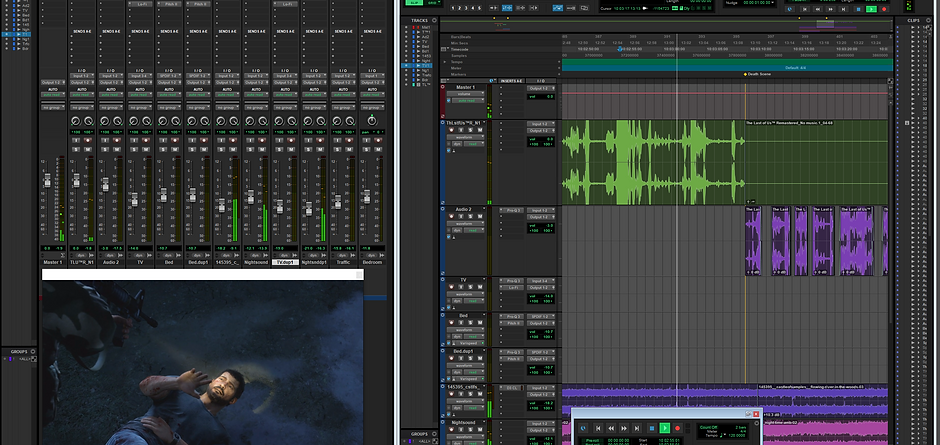
In order to gain a strong emotional response from the participants, one of my personal favourite video games was chosen for its heart breaking opening scene - Naughty Dog’s ‘The Last of Us’. In order to gather appropriate data for my chosen topic, two versions of the opening scene were required: one with music, and one without.
Fortunately, video game engines allow for all audio elements to be adjusted to personal preference. However, these settings do not apply to cutscenes, thus requiring myself to record the full gameplay clip and manipulate the audio within Pro Tools. This was achieved by removing all audio between vocal lines and overlaying bespoke ambient audio, masking any evidence of audio being suddenly removed.


The Questionnaires
Secondary research lead to the discovery of previous studies on the topic of immersive experiences within media, leading to the creation of the Film IEQ - a questionnaire devised for gaining numerical data based on an individuals experienced sense of immersion while engaging with film or video games. This questionnaire was used during the experiments and provided vital evidence of music having an impact on emotional responses from video games.
The Results - Numerical Data
Once participants had been gathered using social media, each questionnaire was complete and the anonymised data was analysed. Responses to each question were assigned a numerical value, processed, and summed, providing a comparison between the two groups experience. Due to this process, it is determined that a higher value indicates the participant experienced a stronger sense of immersion. The questionnaire consisted of 24 questions, resulting in a maximum score for everyone as 120.
Numerical values were assigned to each of the four sub-groups. Each category had an independent scale as they had differing totals; Captivation, 12 – 60; Real-World Dissociation, 3 – 15; Comprehension, 4 – 20; and Transportation, 5 – 25.
Video 1 was found to have a higher overall immersion score, with 90.1 compared to 82.6. Indicating that those who had accompanying music found the experience more immersive, thus highlighting that music has a large role in immersive experiences.
Each set of data was broken into their four-factor sub-groups. Video 1 was found to have a higher indication of Captivation: with a score of 51.9 compared to 45.4. Video 1 was also found to have a higher indication of Real-World Dissociation: with a score of 11.9 compared to 10.8. Video 1 also featured a higher indication of Comprehension: with a score of 12.5 compared to 11.3. Video 2 indicated a higher response in the Transportation sub-group: however, the difference is not statistically significant, with a score of 15.1 compared to 14.9.
These findings indicate that with music, video games can captivate a larger audience – using sonic procedures, dynamic soundtracks and reactive environments, these sub-groups scores can be greatly increased. It also indicates that with the higher level of dissociation from the real-world and comprehension, users can place themselves within these virtual worlds with ease – allowing for otherworldly events to become grounded, even within the real-world. One outlying statistic for transportation, concluded that users found the events without music more realistic – managing to place themselves within the story and increasing the authenticity of the shown events. This is supported further by the qualitative statements from each questionnaire.


Results - Opinions
Overall, video 1 was found to have a higher measurable level of immersion. Participants found that with music, it allowed for context, themes, and emotions could be communicated more effectively. With those stating: “It gave you a sense of what is going on in the scene” and “The music provided a sense of threat to the scene making the experience more emotional”. Participants also found it difficult to comprehend these scenes without music: “Too much silence would create an awkward gap”.
The use of music achieved a great sense of captivation. Participants felt the main themes of the game were heightened, leading to an emotional climax at the end: “The scenes with music were the ones that gripped me the most”, and “[the music] triggered emotional cues of the scenes, without it I feel it wouldn’t have been as effective”.
This also allowed participants to comprehend the images, themes, and story, and place themselves within, even with such extravagant concepts such as a zombie outbreak, stating: “the music did a good job of creating the mood with the scenes, without overshadowing them”.
However, as discussed, participants found the video without music more grounded and realistic. Allowing for a connection to the characters, as though they are real people. Stating: “[the lack of music] made me focus on the character dialogue and world events. Giving an ominous quiet feeling towards the start, and a helpless uncomfortable feeling at the end”. Many others mentioned that it was found to improve their immersive state, “the lack of music adds to the narrative by making it more immersive”.
While many statements supported the numerical data gathered, few caused contradictions – outlying from the other participants. While those who heard music felt it was perfectly executed or possibly required more music, those who did not felt the lack of music was the appropriate option – and did not know that it was originally intended to include music. Stating: “it allowed me to feel as though I was hearing and seeing exactly as the characters were” and “On the whole, I like that they went with no music”.
However, this lack of music caused a large dynamic of the atmosphere, tone, and themes to not be communicated as originally intended by the developers Naughty Dog. A lack of music created a personal experience with the story and characters, the full extent of fear, anxiety, and loss struggle to be conveyed. With participants stating: “I think music would’ve made it scary” and “Something was missing, it was jarring”.
Conclusion of Research
This research aimed to measure the effectiveness of music within video games in relation to immersion. The use of music was very effective in improving aspects of a video game’s experience such as comprehension, real-world dissociation, transportation, and captivation. However, contrasting these scenes or elements with those of either silence or purely foley audio creates a personal experience with the games themes and characters, building an intimate experience that allows users to form a relationship with the characters.
To effectively implement music, there must be a contrast to allow for music to elevate atmospheric elements, tone, and emotional impact, especially when dealing with themes of fear and loss, such as the video shown does.